
1. What this soil calculator estimates
The tool calculates the plan area of each rectangular, circular, or single-notch L-shaped bed, multiplies that area by the entered soil depth, and adds the results across as many as 12 beds. It then applies one adjustable settling allowance to the project's geometric volume, allocates that adjusted volume to your mix ingredients, and estimates cost. Bag quantities round up ingredient by ingredient; bulk quantities stay as exact volume estimates in your selected cubic yards or cubic metres.
This is a volume and shopping-planning estimate. It does not select a planting depth, recommend a fertilizer or universal soil recipe, calculate mass from an assumed density, inspect drainage, or decide how much soil a particular crop needs. It also does not subtract wall thickness automatically: enter the clear inside dimensions of the space that will hold soil.
2. Step-by-step: use the calculator
- Choose units. Imperial measurements use feet for plan dimensions and inches for depth; metric uses metres for plan dimensions and centimetres for depth. Switching units converts the values currently entered.
- Name and measure each bed. Measure the open soil cavity inside the walls. Select rectangle, circle, or L shape. For an L, enter the full outside length and width of its rectangular envelope, then enter the two dimensions of the missing rectangular corner.
- Set fill depth. Measure from the bed's usable bottom to the intended soil surface—not automatically to the top of the wall. For uneven fill, split the bed into sections with separate approximate depths or use a representative average.
- Add every bed in the project. Each bed may have a different shape and depth. The shared project mix is applied to the combined soil volume.
- Choose a settling allowance if appropriate. The default 10% is an editable planning buffer only. Review the explanation below; use zero if you do not want an added buffer.
- Define the mix. Adjust the ingredient names and volume percentages until the total reads 100%. Add or remove ingredient rows as needed. Percentages describe a volume recipe, not a weight recipe.
- Choose how each ingredient is sold. Select bags and enter the package's labelled volume and price per bag, or select bulk volume and choose cubic yards or cubic metres with the supplier's price per unit. Bag counts round up separately; bulk volumes do not assume the supplier's minimum or order increment.
- Review the diagrams and list. Compare each dimension-labelled plan view with the real bed, then review the before/after allowance totals and ingredient quantities.
- Print, export, or reset. Print the estimate or download a CSV containing bed measurements, ingredient quantities, purchase units, and entered prices. Reset returns the form to its original example.
Inputs are calculated in the page's JavaScript and are not submitted to a calculator service. A CSV file is created on your device when you choose download.
3. Footprint formulas for the three bed shapes
Rectangle
Area = inside length × inside width. A 6 ft by 3 ft cavity has 18 ft² of plan area. For a metric bed, multiplying metres by metres gives square metres.
Circle
Area = π × (inside diameter ÷ 2)². Measure across the soil cavity through its centre, not around the outside of the frame. The radius is half the diameter.
L shape
Area = overall length × overall width − cut-out length × cut-out width. In this calculator the cut-out is a single rectangle removed from the lower-right corner of the outer rectangular envelope. Both cut-out measurements must be smaller than their matching overall dimensions. A rotated L has the same area when the matching dimensions are swapped. For a more complicated footprint, split it into rectangles, add those areas, or use a more suitable shape method.
The SVG plan views use one common scale per diagram so the shown proportions follow the entered dimensions. Overall dimensions are marked; the L diagram also labels the removed corner. The drawing is a footprint aid, not a construction plan.
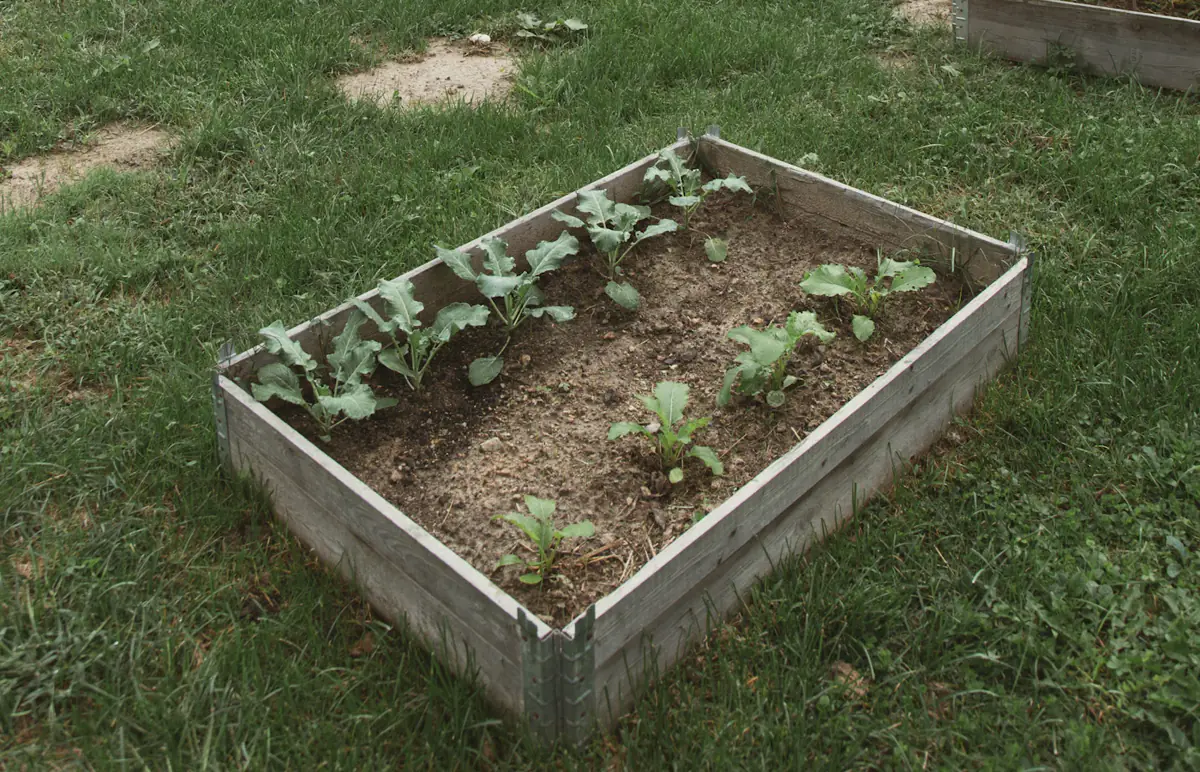
4. Turn footprint area into soil volume
For a bed with a level bottom and uniform fill depth:
- Rectangular-prism volume = area × depth.
- Combined project volume = sum of each bed's area × its own depth.
- Metric: m² × m = m³. The calculator accepts depth in centimetres and divides it by 100 before multiplying.
- Imperial: ft² × ft = ft³. The calculator accepts depth in inches and divides it by 12 before multiplying.
The volume describes the ideal geometric cavity. If walls taper inward, there is a sloped bottom, or the intended fill is below the rim, use dimensions and an average depth that represent the actual fill volume. If depth varies considerably, split the bed into sections and estimate each section separately.
5. What the settling allowance means
The calculation is volume with allowance = geometric volume × (1 + allowance ÷ 100). For example, a 10% allowance multiplies the geometric amount by 1.10. It adds a planning buffer before the mix is divided into ingredients and bags are rounded.
It is not a measured shrinkage factor and does not predict how much a specific mix will settle. Settling depends on materials, moisture, handling, organic-matter decomposition, and how the bed is filled. Oregon State University Extension notes that newly filled beds may sink over time and need topping up; the amount is not represented by a universal percentage. Consider ordering in stages or confirming a product-specific allowance with the supplier. Do not add a buffer twice if a supplier's quoted quantity already includes one.
Because the mix is applied after the allowance, all ingredient volumes include the same chosen buffer. If your project does not need extra volume, set it to 0%.
6. Independently checked imperial example: one 8 ft × 4 ft bed
Assume a rectangle with 8 ft inside length, 4 ft inside width, 10 in fill depth, a 10% allowance, and a 60% topsoil / 40% compost mix. Suppose both ingredients come in bags labelled 1.5 ft³. This example shows the arithmetic; it is not a recommended planting depth or mix for every garden.
- Area = 8 × 4 = 32 ft².
- Depth = 10 ÷ 12 = 0.833333… ft.
- Geometric volume = 32 × 0.833333… = 26.6667 ft³ (0.9877 yd³).
- After allowance = 26.6667 × 1.10 = 29.3333 ft³ (1.0864 yd³).
- Topsoil share = 29.3333 × 0.60 = 17.6 ft³; 17.6 ÷ 1.5 = 11.733…, so buy 12 bags.
- Compost share = 29.3333 × 0.40 = 11.7333 ft³; 11.7333 ÷ 1.5 = 7.822…, so buy 8 bags.
The mixed soil requirement is 29.3333 ft³, while 20 whole bags provide 30 ft³ total. The 0.6667 ft³ difference is due to rounding each ingredient upward separately. This example was independently recomputed from the rectangle, depth conversion, allowance factor, mix shares, and ceiling rule used by the calculator.
7. Independently checked metric example: a 1.2 m diameter circle
Assume one circular bed with 1.2 m inside diameter, 25 cm fill depth, an 8% allowance, the same 60% / 40% volume mix, and package labels of 40 L per bag.
- Radius = 1.2 ÷ 2 = 0.6 m.
- Area = π × 0.6² = 1.130973 m².
- Depth = 25 ÷ 100 = 0.25 m; geometric volume = 1.130973 × 0.25 = 0.282743 m³ (282.743 L).
- After allowance = 0.282743 × 1.08 = 0.305363 m³ (305.363 L).
- Topsoil = 305.363 × 0.60 = 183.218 L; ÷ 40 = 4.580…, or 5 bags.
- Compost = 305.363 × 0.40 = 122.145 L; ÷ 40 = 3.054…, or 4 bags.
The combined purchase is 9 bags, or 360 L labelled capacity, because the two ingredients are rounded separately. The shown example was independently calculated using the circle formula, centimetre-to-metre conversion, allowance multiplication, and the ceiling of each ingredient's package count.
8. Useful volume and bag reference tables
These are unit conversions, not promises about the usable volume or coverage of a particular product. Follow the package label and supplier's sales unit. NIST publishes the customary/SI volume conversion factors; the values below are rounded for convenient planning.
| Volume | Equivalent | Quick conversion |
|---|---|---|
| 1 ft³ | 28.3168 L | Multiply ft³ by 28.3168 for litres. |
| 1 yd³ | 27 ft³ = 764.555 L | Divide ft³ by 27 for cubic yards. |
| 1 m³ | 1,000 L = 35.3147 ft³ | Multiply m³ by 35.3147 for ft³. |
| 1 L | 0.001 m³ | Divide litres by 1,000 for m³. |
Conversion references: NIST Handbook 44 (2026), Appendix C, Tables of Units and NIST Metric Conversion Card (SP 365).
Whole-bag capacity at common labelled volumes
| Number of bags | 1 ft³ bags | 1.5 ft³ bags | 40 L bags |
|---|---|---|---|
| 5 | 5 ft³ ≈ 142 L | 7.5 ft³ ≈ 212 L | 200 L |
| 10 | 10 ft³ ≈ 283 L | 15 ft³ ≈ 425 L | 400 L |
| 20 | 20 ft³ ≈ 566 L | 30 ft³ ≈ 850 L | 800 L |
Those capacities are multiplication examples only. Actual package sizes vary. A label in pounds or kilograms is a mass, not a volume; converting a weight-labelled bag into cubic feet or litres requires the product's bulk density and moisture condition.
Illustrative volume by depth for a 32 ft² footprint
| Uniform depth | Volume before allowance | Approximate yd³ |
|---|---|---|
| 4 in | 10.67 ft³ | 0.40 yd³ |
| 8 in | 21.33 ft³ | 0.79 yd³ |
| 12 in | 32 ft³ | 1.19 yd³ |
Each row is 32 ft² multiplied by depth in feet. It excludes an allowance, package rounding, walls, uneven bottoms, and any crop-specific decision about rooting depth.
9. Choosing and entering soil mix percentages
A percentage in this tool means a share of total mix volume. For an ingredient, volume needed = project volume with allowance × percentage ÷ 100. The calculator does not convert the recipe to weight percentages; ingredients have different bulk densities, so 60% by volume is not necessarily 60% by mass.
The initial 60% screened topsoil / 40% finished compost values are only a convenient editable starting example. Extension advice differs with climate, native soil, crop, product, and the purpose of the bed. For example, University of Minnesota Extension describes a topsoil-and-plant-compost mix in a range around one-half to two-thirds topsoil, while also warning that excess compost can create water-retention and nutrient issues. Oregon State University Extension discusses a different approach in which compost may be added to existing or excavated soil and notes that filled beds can settle. These are regional examples, not a universal recipe. Ask a local Extension service or soil-testing lab for crop- and soil-specific guidance.
Use the exact names of what you plan to buy—such as screened topsoil, compost, coir, or a labelled raised-bed blend—and verify the bag's labelled volume. Entering a mix is an accounting step for quantities and cost; the calculator does not judge whether a proposed combination is horticulturally appropriate.
Guidance consulted: University of Minnesota Extension, Raised bed gardens; Oregon State University Extension, How to use compost in gardens and landscapes; and OSU Extension, Raised bed gardening.
10. Common estimating mistakes
- Using outside frame dimensions. Thick walls displace soil. Measure clear inside length and width or diameter.
- Forgetting the depth conversion. Ten inches is 10/12 ft, not 10 ft; 25 cm is 0.25 m, not 25 m.
- Entering an L's outer envelope as filled area. The L tool subtracts one corner rectangle. Verify that the cut-out labels match the missing part.
- Mixing horizontal and depth units. Imperial plan dimensions are feet but depth is inches; metric dimensions are metres but depth is centimetres.
- Measuring wall height instead of soil depth. Freeboard, a false bottom, drainage space, or a sloped floor can make the actual fill shallower.
- Assuming a bag's mass tells its volume. Moisture and bulk density vary. Use a volume label or the supplier's product-specific conversion.
- Rounding a combined mix only once. Soil, compost, and amendments are separate purchases; each bag count is rounded up independently, so the combined bag capacity can exceed the requested volume.
- Treating the allowance as a scientific settling prediction. It is simply a user-chosen extra percentage; a percentage does not correct wrong dimensions or an unsuitable recipe.
- Entering a percentage recipe by weight. The mix fields use volume fractions. Verify every ingredient share and make the total 100%.
- Adding a second buffer. Check whether the supplier or product quantity already includes overage before ordering extra again.
11. Purchasing bags or bulk soil
Before checkout, compare each ingredient with the product's printed package volume or the supplier's bulk quote, minimum order, and delivery constraints. Package sizes and terminology differ by brand and location; this calculator does not assume a universal bag size or bulk-order increment.
- Read whether the label states litres, cubic feet, or only weight. Use the stated volume when available; ask the supplier before converting between mass and volume.
- Confirm that each product is appropriate for the intended bed use and is the ingredient described by your mix. A general garden soil, potting mix, compost, and topsoil are not interchangeable labels.
- For bulk material, select the quote's cubic-yard or cubic-metre unit and enter the price per unit. The calculator multiplies the unrounded required volume by that price; ask about minimum loads, order increments, moisture/settled state, delivery charges, and unloading access before treating the subtotal as a quote.
- Review ingredient quantities separately. Round each component according to its own package size, then consider whether the supplier offers a combined custom blend that changes the purchase unit.
- Enter current local prices yourself. Bag cost uses whole bags; bulk cost uses the unrounded volume estimate in the selected unit. Both exclude delivery, tax, tools, and separately purchased amendments.
- If uncertain about the first fill or future top-up, consider a staged purchase or confirm product-specific guidance locally rather than relying on a generic allowance.
The printable summary and CSV are planning aids. Supplier descriptions and the actual package label should take precedence over rounded calculations in a purchase order.
12. Raised bed soil calculator FAQs
How much soil does an 8 ft × 4 ft raised bed need?
It depends on the inside fill depth. Its area is 32 ft². At 10 inches deep, 32 × 10/12 = 26.67 ft³ before an allowance. Choose a depth for your bed and plants, then compare the result with product sizes; the calculator's example depth is not a crop recommendation.
How do I calculate soil for a circular bed?
Measure the inside diameter, halve it to get radius, calculate π × radius² for area, and multiply by fill depth. Keep the units consistent; the calculator converts its entered centimetres or inches before multiplying.
How does the L-shaped bed measurement work?
Measure the overall rectangular envelope, then measure the missing rectangular corner's length and width. Subtract the corner area from the envelope area. This tool handles one square-corner notch; break more complex outlines into multiple simpler beds or sections.
Should I measure the inside or outside of the bed?
Use inside dimensions at the soil cavity. Wall thickness occupies space and should not be counted as fill volume. Measure the depth from the bed floor or false bottom to the intended soil level.
What settling percentage should I use?
There is no universal number. The value only adds the chosen percentage to geometric volume; it is not a prediction of settling. Material composition, water, filling method, and decomposition affect future level changes. Check supplier or local Extension advice, or set 0% if you do not want a buffer.
What is a good soil mix percentage?
It depends on native soil, product, climate, and what you are growing. The calculator's editable topsoil/compost example is not universal guidance. Check a local Extension service or soil test recommendations and enter that recipe as volume percentages.
How many bags should I buy?
Divide each ingredient's required volume by that ingredient's labelled bag volume and round upward to a whole bag. The tool does that separately for each ingredient; the total capacity purchased can therefore be a little greater than the estimated mix volume.
Can I price a mix by bulk volume?
Yes. Set that ingredient to bulk, choose the unit used by the supplier's price (cubic yards or cubic metres), and enter the price per unit. The quantity and cost use the exact calculated volume without supplier minimums or order increments, so confirm those separately. Bag and bulk purchases can be mixed across ingredients.
Can I combine beds with different shapes or depths?
Yes. Add each bed, select its shape, and enter its own dimensions and depth. Each geometric volume is calculated independently and then summed before the shared settling allowance and mix are applied.
Can I convert a bag's weight into cubic feet or litres?
Not from weight alone. A valid conversion requires the particular material's bulk density and relevant moisture/packing condition. Use the labelled volume or ask the supplier for a product-specific conversion.
Why does the mix percentage have to total 100%?
The entered percentages allocate all of the project's soil volume among the listed ingredients. A total below 100% leaves some volume unassigned; above 100% counts more material than the project requires.
Does the allowance include future refills?
It is only an added buffer applied now. The calculator cannot predict future compost decomposition or the level change for a specific mix. Recheck the bed after it settles and top up based on the actual depth needed.
Are my dimensions and prices sent to a server?
No. The page calculates locally in your browser, with no account, database, or calculator API. The CSV is assembled in the browser when you choose to download. This describes the current page behavior and should be reviewed if the page's scripts or data flow change.