1. What does a gravel path material calculator estimate?
A gravel path calculator turns a measured footprint and chosen layer depths into approximate material quantities. This tool estimates a base layer and a decorative surface separately, then shows their volumes, density-based mass estimates, optional edging and fabric, waste-adjusted quantities, purchase-unit rounding and cost from prices you enter.
It models one rectangular path. It cannot inspect the site, determine a suitable construction depth, test soil or drainage, account for every curve and grade, confirm vehicle access, or predict a supplier's exact delivered load. Treat the result as a transparent starting point for checking measurements and discussing specifications with a local supplier or qualified professional.
2. How to use the calculator
- Measure the path length. Follow the route along its centerline from one end to the other. For a curved path, measure the curve rather than the shorter straight-line chord.
- Measure the width. Use the finished inside width between edging. If it changes, take several measurements and use a reasonable average, or divide the path into sections and calculate them separately.
- Choose the base depth. Enter the intended depth of the aggregate foundation, using local guidance for soil, drainage and the expected use. Set it to zero only if your plan genuinely omits a base layer.
- Choose the decorative surface depth. Enter the loose depth you expect to spread over the base. The finish may settle or move; the required depth depends on the stone and site. Set it to zero only if you are estimating base material alone.
- Select each material and density. The listed densities are editable starting estimates. Replace them with the supplier's bulk density or product data when it is available, and match the material state—loose or compacted.
- Set a waste allowance that fits the job. Consider irregular edges, uneven excavation, spillage and the smallest amount your supplier will sell. The default is only a starting point; there is no percentage that fits every site.
- Enter purchase units and prices. Open “Purchase units and prices,” select how each layer is sold and enter a price per unit. Prices are your inputs; the calculator does not look up local rates.
- Read the results in order. Compare the calculated volume before allowance, volume after allowance, estimated weight and rounded full-unit purchase quantity. A rounded order can be materially larger than the mathematical volume.
- Prepare the shopping list. Check the assumptions, confirm the supplier's unit and load increments, then print/save the estimate or export the values as CSV for your notes.
3. Understanding the layers of a gravel path
Prepared ground is the excavated and shaped subgrade beneath the path. Organic matter, soft spots, slope and water movement affect how a path performs. This calculator does not prescribe excavation, geotextile selection, drainage or compaction methods.
Aggregate base is a supporting layer placed over the prepared ground where the project design calls for it. Its material, gradation and compacted thickness depend on the soil, intended traffic and local practice. The tool labels some base materials “compacted,” but it does not calculate the loose delivery volume required to achieve a specified compacted lift.
Decorative surface gravel is the visible top material. Its size, shape, depth and edging affect appearance and how readily it stays in place. Loose stone can migrate underfoot or with rain, and different products have different bulk densities.
Thickness in the calculator is the depth entered for each layer; the volume formula assumes a uniform thickness across a level rectangular footprint. On a sloped or uneven site, the real volume may differ. Loose aggregate occupies a different volume from the same aggregate after placement and compaction, so confirm whether a supplier's specification describes loose, compacted or in-place material. Federal Highway Administration earthwork tables distinguish in-situ, loose and embankment states and show that material state changes density and swell; that road-earthwork reference explains the distinction, but it is not a garden-path design standard.
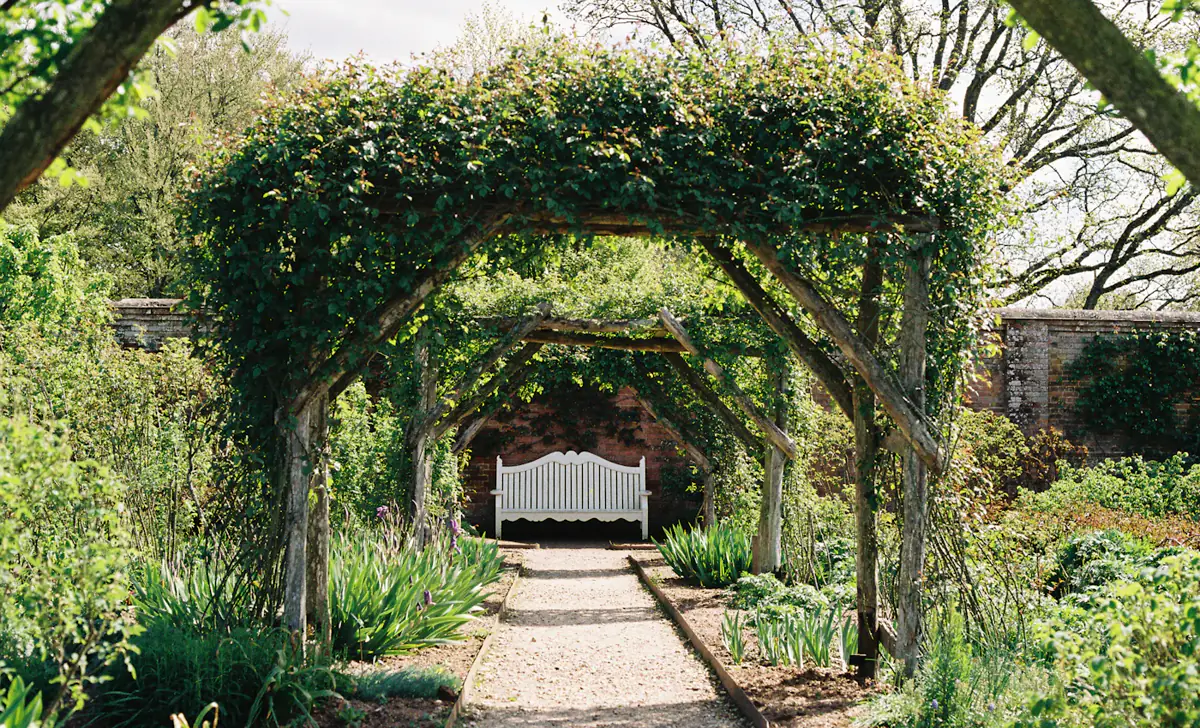
Water should have a sensible route away from buildings and should not be redirected onto neighboring property. Local soil, freeze-thaw conditions, slopes, utilities and access can change what is appropriate. Use the diagram as a quantity illustration, not as construction guidance.
4. Gravel volume formulas
For a uniform rectangular layer, calculate the footprint area and multiply it by that layer's depth. Keep all dimensions in compatible units before multiplying.
Area = length × widthLayer volume = length × width × depthDepth in feet = depth in inches ÷ 12Cubic yards = cubic feet ÷ 27For example, a 24 ft by 4 ft path has an area of 96 ft². At 4 inches deep, convert 4 ÷ 12 = ⅓ ft, then calculate 96 × ⅓ = 32 ft³. Divide by 27 to express that volume as cubic yards: 32 ÷ 27 ≈ 1.19 yd³.
In metric units, convert centimetres to metres by dividing by 100. For an 8 m by 1.2 m footprint at 10 cm deep, volume is 8 × 1.2 × 0.10 = 0.96 m³. For a path with bends or changing width, divide its footprint into rectangles or other manageable shapes, calculate each layer segment, and add the volumes.
5. Volume, mass and material density
Volume describes how much three-dimensional space a layer occupies. Mass describes how much material is there. The calculator estimates mass from volume and the density you provide:
Estimated mass = volume × bulk densityUse m³ × kg/m³ to get kg, or ft³ × lb/ft³ to get lb.Density is not a fixed property shared by every product called “gravel.” Stone type, particle-size distribution, void space, moisture, handling and compaction all influence bulk density. A cubic metre of one loose decorative stone therefore need not weigh the same as a cubic metre of compacted road base. The calculator's built-in values (1,900 kg/m³ for compacted road base and 1,600 kg/m³ for loose pea gravel) are editable starting assumptions, not universal product specifications.
As one context-specific example, MassDOT's estimating guidance uses 3,300 lb per cubic yard for pea stone when estimating a large driveway quantity. That is a transportation-department estimating value for a stated use, not a guaranteed density for every bag or local stone. Ask the supplier for the exact product's bulk density or weight-to-volume conversion. A mass-based order in tonnes or US tons cannot be inferred from cubic yards without such a density.
6. Choosing a waste allowance
An allowance adds material above the ideal geometric volume. It can help account for small measurement errors, uneven excavation, spillage, trimming at edges, settling, inaccessible corners or ordering increments. It does not correct a poor depth assumption, compensate reliably for an unknown compaction factor, or replace a supplier's conversion between loose and compacted material.
There is no universally correct percentage. A straight, accurately excavated path with supplier-confirmed quantities may need a different allowance from a curved route over irregular ground or a project where stone is hard to spread evenly. Think through the actual sources of loss, compare the resulting quantity with available load sizes, and revise the percentage when you have better information. The calculator applies the chosen percentage to both material volumes and estimated masses before rounding each layer to whole purchase units.
7. Worked example: 24 ft × 4 ft path
Use a 24 ft path, 4 ft wide, with a 4 in base, a 2 in decorative surface and 10% waste. The example assumes a consistent rectangular footprint and uniform depth. These are quantity calculations only; the depths are not a construction recommendation.
| Step | Base | Surface | Combined |
|---|---|---|---|
| Footprint area | — | — | 24 × 4 = 96 ft² |
| Depth in feet | 4 ÷ 12 = ⅓ ft | 2 ÷ 12 = ⅙ ft | — |
| Volume before waste | 96 × ⅓ = 32 ft³ | 96 × ⅙ = 16 ft³ | 48 ft³ = 1.777… yd³ |
| After 10% allowance | 35.2 ft³ | 17.6 ft³ | 52.8 ft³ = 1.955… yd³ |
| Displayed, rounded | 1.30 yd³ | 0.65 yd³ | ≈ 1.96 yd³ |
The calculator keeps the calculation precise internally and displays rounded values. If each layer is purchased by whole cubic yards, the base rounds up from about 1.30 yd³ to 2 yd³ and the surface rounds up from about 0.65 yd³ to 1 yd³. The resulting 3 yd³ purchase total is larger than the combined mathematical estimate because each layer is rounded independently.
Weights and costs depend on the density, purchase units and prices selected. For the defaults in the calculator, weight is estimated from 1,900 kg/m³ for the base and 1,600 kg/m³ for the loose surface gravel. Change those assumptions to match supplier data before relying on a mass-based order.
8. Separate metric example: 8 m × 1.2 m path
For a separate example, use an 8 m long path with a 1.2 m average width, a 10 cm base, a 5 cm decorative surface and an 8% allowance. Assume the path is rectangular and the entered depths are uniform.
- Area: 8 × 1.2 = 9.6 m².
- Base depth: 10 cm ÷ 100 = 0.10 m; base volume: 9.6 × 0.10 = 0.96 m³.
- Surface depth: 5 cm ÷ 100 = 0.05 m; surface volume: 9.6 × 0.05 = 0.48 m³.
- Total before allowance: 0.96 + 0.48 = 1.44 m³.
- After 8%: base 0.96 × 1.08 = 1.0368 m³; surface 0.48 × 1.08 = 0.5184 m³; combined 1.5552 m³ (about 1.56 m³).
If both layers were sold only in whole cubic metres, those layers would round separately to 2 m³ of base and 1 m³ of surface. A supplier who sells fractional quantities or quotes by mass may produce a different order; confirm the available unit and density rather than treating the rounded illustration as a purchase recommendation.
9. Reference tables for volume and ordering
Useful volume conversions
| Starting volume | Equivalent | How it helps |
|---|---|---|
| 1 cubic yard | 27 ft³ = 0.764554857984 m³ | Divide ft³ by 27 to get yd³. |
| 1 cubic metre | 35.31467 ft³ = 1.307951 yd³ | Multiply m³ by about 1.308 to get yd³. |
| 1 inch | 25.4 mm | Convert depth before calculating metric volume. |
| 1 foot | 0.3048 m | Convert each length before multiplying in metric. |
Volume conversion factors follow NIST Handbook 133, Appendix E (2026). One cubic yard equals 27 cubic feet; the handbook lists 1 yd³ as 0.764554857984 m³.
Density examples and assumptions
| Example | Density or reference | How to interpret it |
|---|---|---|
| Calculator base default | 1,900 kg/m³, compacted road base | Editable tool assumption, not a universal specification. |
| Calculator surface default | 1,600 kg/m³, loose pea gravel | Editable tool assumption, not a universal specification. |
| MassDOT pea-stone estimate | 3,300 lb/yd³, about 1,960 kg/m³ | MassDOT uses this for large driveway quantities; context-specific, not a guaranteed product value. |
The MassDOT value is from its Plans, Specs and Estimates guidance. The FHWA Earthwork Design reference separately identifies in-situ, loose and embankment states. Neither source makes one density correct for every retail gravel product.
Bag volume compared with bulk volume
| Purchase description | Mathematical comparison | What to check |
|---|---|---|
| Bulk cubic yard | 27 ft³, or about 764.6 L | Ask whether the supplier quotes loose volume, minimum loads or fractions of a yard. |
| A bag labelled 0.5 ft³ | 54 such labelled bags equal 27 ft³ by volume | This is arithmetic for that stated label only; bag sizes and actual stone volumes vary. |
| A 20 kg bag | 20 kg is mass; volume cannot be found without bulk density | Check the product label or supplier data. Do not assume a standard coverage rate. |
| A 50 lb bag | 50 lb is mass, approximately 22.68 kg | Use the material's stated density to compare with a volume-based estimate. |
A bag count calculated by volume is not necessarily a weight-based bag count. Packaging labels and supplier specifications control. The examples above compare units only; they do not state universal product sizes or coverage rates.
Illustrative quantities for a 96 ft² footprint
| Uniform depth | Volume before waste | Approximate cubic yards |
|---|---|---|
| 1 in | 8 ft³ | 0.30 yd³ |
| 2 in | 16 ft³ | 0.59 yd³ |
| 4 in | 32 ft³ | 1.19 yd³ |
These are ideal geometric volumes only: 96 ft² × depth in feet, then divide by 27. They exclude allowance, compaction changes, supplier rounding and any site-specific design requirements.
10. Common quantity-estimating mistakes
- Mixing inches and feet. Convert inches to feet before using a cubic-foot calculation; multiplying by “4” as if 4 inches were 4 feet makes the result twelve times too large.
- Confusing loose with compacted volume. A finished compacted depth may require a different loose delivery volume. Use a supplier or project specification's conversion factor when needed.
- Assuming every gravel has the same density. Stone type, grading, moisture and packing change mass per unit volume.
- Ordering only the exact rectangle formula. An ideal volume excludes site variation, handling loss and supplier minimum quantities. Consider those separately instead of treating the formula as an order guarantee.
- Confusing cubic yards with tons. One is volume and the other is mass. Convert only with an appropriate material density and the supplier's definition of “ton.”
- Ignoring changes in path width. A single average can misstate a path with broad bays or narrow connectors. Split the footprint into sections where that improves the estimate.
- Rounding too early. Keep unrounded layer volumes through the allowance step, then round purchase units at the end. This calculator rounds each material separately only for the purchase estimate.
11. How to check and order the materials
Before placing an order, compare the estimate with the exact aggregate and packaging you intend to buy. A short supplier check can resolve the most important uncertainty: whether the quoted figure describes loose volume, compacted volume, mass or a fixed package size.
- Confirm the product name, stone size or grading, and whether it is intended for a base layer or visible surface.
- Ask for the supplier's bulk density, mass per cubic yard, or conversion between the quoted loose and placed/compacted quantities. Avoid substituting a generic density from a different gravel.
- Confirm the sales unit, minimum quantity, truck capacity, delivery charge and any rounding rule. Check that “ton” means a US short ton or metric tonne as expected.
- For bags, use the package's labelled mass or volume and any product-specific coverage statement. Do not infer cubic volume from bag mass without density.
- Compare the supplier's final quantity with each layer separately. Base and surface stone may be sold by different units and should not be merged into one mass estimate.
- Check access, unloading location, drainage, edging and local construction guidance independently. A material calculator cannot assess those site conditions.
Prices in this tool are entered by you and are multiplied by the rounded quantities. They are not live, region-specific prices and do not include delivery, tax or equipment unless you add those costs separately.
12. Gravel path calculator FAQs
How much gravel do I need for a path?
Measure the path's area and multiply it by the depth of each material layer. For a rectangular path, area is length × width; calculate the base and visible surface separately, then add a project-specific allowance. Compare the result with supplier units and the loose or compacted state described by the supplier.
How do I calculate cubic yardage?
First calculate cubic feet using length × width × depth, with depth converted to feet. Divide cubic feet by 27 because one cubic yard contains 27 cubic feet. In metric, calculate cubic metres directly and use the conversion table only if the supplier quotes cubic yards.
What is the difference between gravel volume and weight?
Volume is the space occupied by the gravel; weight (more precisely, mass in the calculator's formula) depends on volume multiplied by bulk density. Moisture, grading, void spaces and compaction can change the density. A volume estimate is not a tonnage estimate until the relevant density is known.
How do I estimate tons of gravel?
Use a product-specific bulk density to convert the volume to mass, then divide by the unit mass. For US short tons, divide pounds by 2,000; for metric tonnes, divide kilograms by 1,000. Check the supplier's unit definition and use the matching material state and density before ordering by mass.
What if my path changes width?
Measure the width at several points. For a gently varying path, an area-weighted average width can be a practical approximation; for paths with distinct wider and narrower sections, split the route into rectangles, calculate each section's layers and add the volumes. The built-in edging estimate assumes one rectangle, so measure the actual edging run separately for an irregular path.
Why does compacted volume differ from loose volume?
Loose aggregate contains more void space and can settle as it is spread and compacted. The delivered loose quantity needed for a specified finished layer depends on the material and placement method; there is no single conversion for every stone. Ask the supplier or project specification for the relevant swell/compaction factor.
How should I use the waste allowance?
Choose an allowance based on the shape and accuracy of the excavation, handling losses, uneven ground and the supplier's minimum order units. The calculator's 10% starting value is editable and is not a universal recommendation. A waste percentage does not fix a wrong depth or an unknown loose-to-compacted conversion.
Can this calculator replace construction or drainage guidance?
No. It estimates material quantities from dimensions and densities that you provide. It does not inspect soil, design drainage, specify excavation or compaction, locate utilities, check permits or determine suitable construction layers. Follow local requirements and get site-specific guidance where needed.
Are my project inputs processed in my browser?
Yes. In this static page, the calculator's JavaScript reads the form values and performs the calculation locally; the page contains no database, account system or calculator API request. The CSV is assembled in the browser when you export it. This answer is based on the current page code; if analytics, external scripts or a backend are added later, the data-flow statement should be reviewed again.